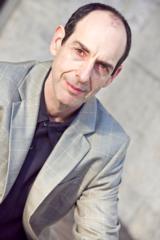
 "Acting is doing. It is not talking about, thinking about or feeling about. Acting is doing, and listening is a doing." In an earlier entry I described the profound and challenging experience I had in a two week True Acting Institute based on the Meisner Approach under the direction of Larry Silverberg. In this entry I want to provide just a few specific examples from the vast array of insights/experiences about true acting that I received. If you wish to have a complete account of the content of the Institute, I encourage you to read Larry's own books on the Meisner Approach. Like the little book of St. Ignatius Loyola on the "Spiritual Exercises", Larry's books are primarily a series of exercises designed to produce an experience. And while reading is helpful in both cases, it is only the doing that can transform.
The first insight/experience was that acting is doing. It is true that words are important. It is also true that emotions are important. But acting is all about doing, and really doing what you are doing. From one of the exercises I came to experience that while I think I am doing what I am doing, usually I am half-focused on something else. For example, while eating lunch I am distracted watching tv; later while writing a get-well letter I am imagining what the coming weekend has in store, and so on. An actor has to be 100% attentive and available to what he is doing, otherwise he is out of the ball game – just as we are out of the ball game in real life. An actor has to be fully available to what is going on, otherwise he is only making it look like he is doing what he is doing and hoping he is fooling the audience in the process (which he isn't) – just as in real life. This reminds me of the motto of my undergraduate university, St. Mary's in Halifax. Emblazoned on the marble floor of the foyer are the Latin words: "Age quod agis" (Do what you are doing). When I first came across these words in 1962 I thought they were silly because they were so redundant. But now I know there is a great and simple – if difficult to achieve – wisdom to them.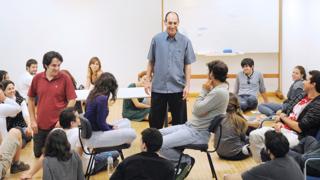
It is this coming to be able fully to do (which I cannot go into here) that then makes the words which the actor speaks absolutely necessary to say. It is from this real doing that the emotions arise and in turn serve. Larry gave this very helpful example. Suppose there is a serious car accident out in front of your house. You rush out and begin to rescue the person trapped in a burning car. As you do this, are you asking yourself, "Am I having the appropriate emotions here? Are my emotions intense enough? subtle enough? Do the people watching me think that I am having all the right emotions?" Of course not. If you are really doing what you are doing, your attention is focused on what you are doing, and everything flows from that. The only reason you would be asking those questions is if your attention is on yourself? And then you are not really doing what you are doing – only pretending to. Similarly, those learning to act frequently ask the question, "What do I do with my hands?" Would you be asking yourself that question if you were really rescuing someone from a burning car? No, because when you are really doing what you are doing, your hands will take care of themselves. It is only when your attention is on yourself that these questions arise in your mind.
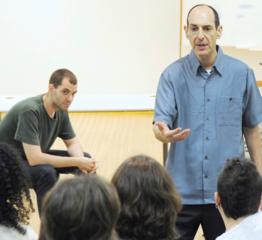 All of this gives rise to a second vital insight/experience. Actually this is the most foundational, and Larry had us do many exercises to effect this experience in us. If your attention as an actor is not on yourself, what is it on? What are you responding to? To state it precisely, your attention is on your partner, that is on the other actor/s – indeed on the whole environment of the stage/scene. It is absolutely vital for living drama to occur that an actor be fully available to his/her partner at all times, otherwise no creativity can occur, no act of creation. I can only state, and not elaborate here, the three dimensions to this experience. (1) in acting do not do anything until something makes you do it; (2) that "something" comes from "over there", i.e. from your partner; and (3) that "something" is also felt "over here", i.e. it does something to you and you respond.
This approach was quite different from my earlier experience of acting. Back then I simply memorized my lines all by myself in my room, worked out how they should be said and practiced that. Then during rehearsals – and God forbid performances – I just gave my lines as I practiced them regardless of what the other actor/s were doing and saying and how they were doing and saying it. And they in turn were doing the same. So it really didn't matter who was there doing what. Not exactly a recipe for vibrant theatre. Similarly with real living, if we are not fully available to whom we are relating and are responding to them as such, our exchange is hardly a living one and certainly not a truly human one.
Thirdly, for the act of creation to occur, the actor has to get out of his own way. I have given just a few clues as to how that might occur. Once the actor is out of his own way he enters the realm of the unknown and it is there that creation occurs. It is there that the audience is seized up into their own humanity and come away having experienced something real, something that may begin to change them. The actor is no longer doing the drama, the drama is doing the actor. The actor has allowed himself to become an artist. Acting is the most intimate of all art forms. The actor creates with his whole self, all of himself, his fears, his courage, his demons, his triumphs, his past, his present, who he is now – all is embraced, nothing is denied.
As Larry has said, "The Meisner Approach is lifting the actor to the spiritual experience where the actor actually becomes an empty vessel, and where now, something greater than the actor himself can express itself through him."
Is that not what Christian spirituality also is all about (2 Cor 4:7)?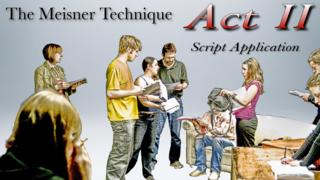
True Acting and True Living nourish each other. Becoming better at one makes you better at the other. It was an honour and a privilege for me to have been part of such an endeavour with such genuine people. As with my experience of the Spiritual Exercises of St. Ignatius, I experience the exercises of the True Acting Institute to continue to nourish me both personally and my priesthood for others.
If any of what I have spoken about sets off a spark in you as well, you can contact Larry at: trueactinginstitute@aol.com