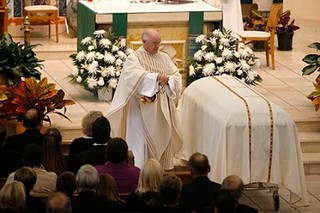
Recently I was called upon to celebrate a Mass of the Resurrection in a nearby parish church. The priest had a difficult decision to make, whether to take the funeral or cancel a long-standing commitment. When he asked if I could help him out, knowing something of his busy schedule, I was pleased to lend a hand.
I did not know the family or the deceased, a woman who had lived a long and holy life. She was a widow of many years who was left to oversee the growing up of her five children long before the term “single mom” came into use. From all accounts she took things in stride without complaint. From every side, too, she did everything right, and the tributes to her reflected that fact above all else.
Celebrating a funeral for someone unknown is not easy, I find. Care has to be taken to get it just right and, especially in the homily, not to infer that one actually knew the deceased. For the family members and others present, that would seem insincere. It took several hours of writing to catch the correct tone for the homily. The liturgy unfolded well, fortunately.
That was the first time I have celebrated a funeral since the new translations of the missal came into use. One would like to say that the prayers for the funeral (Collects, Offertory Prayers, Post Communion Prayers) follow well the rhythms and sense of the English language.
Admittedly, the prayers I chose were a much better fit than many we have to bear during Sunday Eucharistic liturgies, with their often complete disregard for the English language. Someone should have told whoever composed the prayers for the Sunday and week-day liturgies that literal translations from Latin don’t necessarily work!
There is something stilted about the new prayers, and no amount of excuses or rationalizations will cover that fact. Yet there it is! 
Afterwards I was invited to accompany the funeral cortege to Notre-Dame cemetery across town. As we set off in a rather splendid black lead-car, the driver, a friendly man, gave me a plasticized sheet of prayers for the burial ceremony. “Why not take these?” he said cheerily, as he handed it over. “That way you won’t get your bible wet.” I was carrying the burial ritual, and rain was falling gently.
As we drove along amidst what seemed like a lot of discourteous drivers–no longer the waiting by other drivers for the funeral procession to pass, no longer any moving through red lights or stop-signs–cars were darting and dashing around us.
One driver actually had the temerity to blow a rather loud horn at us, clearly out of frustration at the slowness of the lengthy procession. What has happened to that politeness so evident of Canadians, or at least according to visitors to Canada?
Glancing over the prayers for burials, I was relieved to see that these prayers remain for the most part untouched by translators, or at least do not seem noticeably clumsy and unfitting for English.
Ever mindful of what had occurred nearly forty years ago on a wet and cold November day at the burial site of our father, when the local parish priest droned on and on and on, apparently reading every prayer in the book, I was brief. Most mourners prefer that.
It is a difficult enough moment leaving a loved one in the earth to await the resurrection without having to bear an over-abundance of prayers. Usually a few well-chosen ones will suffice quite nicely.
Afterwards we then departed, leaving the deceased to God’s mercy.