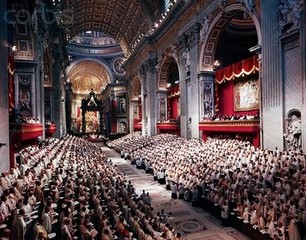
 As we look back in this Year of Faith to the Second Vatican Council, a question that inevitably arises is, “What did the Council change?” Implicit in any answer to this question are notions of what the Church was like both before and after the Council. Much of the time, however, we are presented with overly-simplistic narratives about the pre-conciliar–and increasingly the post-conciliar–Church. It is a worthwhile exercise to examine these narratives, as a sort of propaedeutic to understanding Vatican II.
It is very common to hear that the pre-Vatican II Church–or more specifically, the Church during the nineteenth and early twentieth-centuries–was ossified, rigidly conservative, legalistic and Eurocentric. For example, a book I once read on the history of the Society of Jesus referred to the Jesuits of the nineteenth century as “the grenadiers of an immobile Church”.
Even when the pre-conciliar Church is spoken of positively, emphasis is usually placed on the sense of certainty among the faithful that imparted a comfortable religious and cultural unity–a viewpoint that essentially reiterates the elements of rigidity and immobility espoused by the openly negative narrative.
Obviously, any generalisation lacks nuance. Take, for example, the condemnation of the modernist heresy by Pope Pius X. The gross narrative I have sketched above would ignore the specific and technical senses with which the term “modernism” is used here, leading to the false impression that the Church opposed modernity in general, or even, to take an absurd example, concluding that the Church officially objected to, say, the Modernist art movement. Pius X clearly did not oppose everything modern–else how could he have been reconciled to great saints like St. Ignatius of Loyola, who was thoroughly modern in the broad sense of the term? 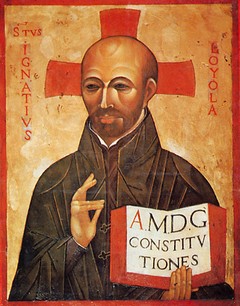
However, even if we grant that nuance is lacking in this vision of an ossified pre-conciliar Church, might we still not concede that it is nonetheless accurate enough if we paint with broad strokes? Does it not characterise the general spirit of the Church in those times? I would say that I am highly suspicious that it does, for two reasons that come immediately to mind.
First, attributes of rigid conservatism and legalism seem alien to the style of the great Catholic writers in the pre-conciliar era with whom I am familiar. Take, for example, a famous passage from Chesterton: “People have fallen into a foolish habit of speaking of orthodoxy as something heavy, humdrum, and safe. There never was anything so perilous or so exciting as orthodoxy … in my vision the heavenly chariot flies thundering through the ages, the dull heresies sprawling and prostrate, the wild truth reeling but erect.”
This seems very far from the image of a dour Catholicism that we are often presented with. So too is the fresh, passionate and original literature of G. M. Hopkins. Graham Greene’s explorations of complex moral problems (his most celebrated novels are from before Vatican II) are anything but rigid.
Even Evelyn Waugh, who was, it is quite safe to say, very conservative, has a deep and tender romanticism running through Brideshead Revisited and The Sword of Honour, novels far more concerned about the law of love than any other type of law. Notably, all four of these authors were converts to Catholicism. It seems to me that they must have found something more than mere certainty and security–if they even found these: Greene certainly didn’t. They found something that animated their souls.
If it could be argued that these men were exceptions to a rule, and that we remember them only because Catholics more typical of their times have been forgotten, my second objection seems harder to dismiss. It is this: the nineteenth and early twentieth centuries was a period of some of the most vigorous, sustained and successful evangelisation the world has seen, coinciding with a flourishing of new religious congregations.
It was a epoch when large portions of Africa and Asia became Christian. Catholicism became global before the Council, rather than vice versa: the Council recognised, responded and further encouraged this trend, rather than initiated it. Ironically, the assertion that the pre-Conciliar church was Eurocentric betrays a Eurocentric attitude still prevailing today, since it ignores the fact that much of the Church’s dynamism was occurring outside of Europe before the Council.
The common argument that the Church grew on these continents chiefly because of the pressures of colonialism is, I think, largely false. There are many countries where this was certainly not the case. For instance, there are a number of former British colonies and protectorates that now have Catholics representing the largest denomination in the country. Clearly, there would have been no pressure from their colonial authorities to adopt the religion of Rome. 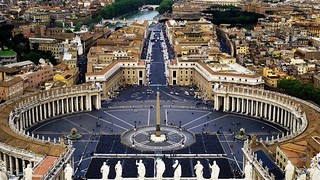
These nations were presented with a faith they found attractive and made their own. And how could they arrive at such a radical change if all they were presented with was ossification and legalism?
Thus, it is grossly inaccurate to speak of an “immobile” pre-Conciliar Church, as the popular narrative would have it. Certainly there was conservatism, reactionism, inertia, intolerance and legalism in the Church. Certainly much was in need of aggiornamento. Certainly the Council and its reforms were necessary and a real grace–“The great grace bestowed on the Church in the twentieth century”, according to John Paul II.
But the tendency to present an unbalanced and caricatured narrative of the pre-conciliar church is too misleading. I would include in this category the opposite narrative to what I have described above: that of a perfect pre-conciliar Church subsequently marred by the reforms.
The real trouble with such narratives is that they obscure the most important thing: the presence of God in the Church. The Church has never been perfect, but she has in all times led people to God. If we present our own cookie-cutter visions of the Church, we will fail to see this and hence completely misunderstand what the Church is.
We will shift the emphasis from Vatican II as the great grace of the twentieth century to Vatican II as the meeting that “fixed” something that was “broken”–or, according to the opposite view, Vatican II as a meddlesome mistake that broke something that was in no need of repair. Either of these two reductions fails to acknowledge God’s Holy Spirit at work in the Church.
Moreover, the approach of pessimistic oversimplification is already striking much closer to home, as we begin to assess the immediately post-conciliar Church. There is a strong tendency today to dismiss the seventies and eighties as fraught with dangerous experimentation, radical rupture from tradition and rampant error. Just as in the pre-conciliar narrative, a part of the true picture–the merely human part–is in danger of being mistaken for the whole.
What is at stake is the same. Will we disown our ancestors in the Faith, claiming full spiritual enlightenment for ourselves? Or will we be grateful for what they have given us, and, despite all our imperfections, past and present, continue to strive to the goal and meet our Bridegroom?