 Part of the tertianship experience for Jesuits entails ministering to the very poor. It is an experiment that forms what Ignatius would call the school of the heart. This was the case during my experiment in Tamale, a northern city in Ghana. I spent six weeks volunteering at a clinic, Shekhina (in Hebrew, God’s dwelling), run by a convert to the Catholic faith, Dr. David Abdulai who freely offers medical care for the very poor of Ghana. In effect, the curing ministry of Dr. Abdulai is so Gospel-inspiring in his radical generosity in our post-modern Christianity.[1] His clinic, no doubt, embodies the Ignatian understanding of school of the heart – the heart that understands the needs of the poor, generously serves them and in the process discovers God anew.
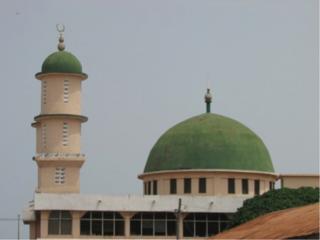
Tamale is a Muslim city (80-90% of its inhabitants today are Muslims) with several Muslim sects professing nuances in their creedal doctrines, namely the Tijaniyya and the Anbariyya both of which have established schools in the city. In addition, the madiyya sect has an active presence and it owns an impressive-looking mosque with large green domes in the city centre. Muslim schools are spread in the city and many of their graduates are learned in some sciences, Arabic (the sacramental language in Islam) and English (the language of commerce).
Sadly, many Tamales do not attend primary schools (estimated as high as 40% of the children), and most who attend school stop their education by age 15 because of material poverty. But Tamale also enjoys an organised Catholic missionary presence[2] serving the population in education, healthcare and cultural integration for new comers. Catholic missions are from the German, Polish, Dutch and the Philippino churches. Contemplative religious life has its own space in Tamale as evident from the presence of cloistered Carmelite convent next to the seminary of the Divine Word (SVD)[3] where I stayed. Religious diversity and serenity are part of the religious character of the Tamalian society. In the city markets it is a common to find a Muslim man sitting quietly, cross-legged on a mat, and praying his beads while next to him are shoppers negotiating the bidding prices. Freedom is another amiable feature as one sees Muslim women running their own motor-bikes commuting from one part of the city to the other. Consequently, the active religious and the secular lives are effectively in close proximity in Tamale.
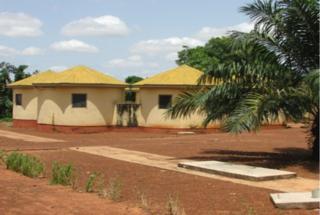 Amid this bustling city, there quietly lies the Shekhina clinic. As early as 5:30 am, the very poor out-patients (most are Muslims) start to queue to be examined by their Dr. Abdulai whom they consider as their godfather in charity. The clinic is situated in a good sized land compound where resident patients live, drug dispensary is kept, registration of patients occurs and minor surgery operations are performed. Volunteer-doctors are in great need, yet some dedicated volunteers of nurses, social workers and other helpers are daily present. By six in the morning the clinic is fully operating. Meanwhile, there are volunteer cooks under Shekhina operation who prepare luncheon meals for the homeless in the city. Shekhina is more than a clinic or a social welfare institution; rather it is a sanctuary of the poor, for the healing of the poor and run by the poor under conditions of material austerity and Gospel inspiration. It is an incarnation of the imperative social Gospel of healing the sick and feeding the homeless all through voluntary poverty and personal generosity.
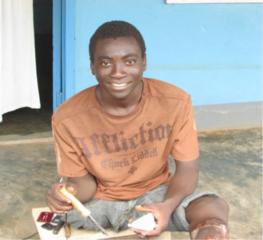 My conversations with the out-patients reveal their perspective of sickness. First, they do not categorise sickness into different types; sickness is sickness regardless if it is arthritis, ulcer, vomits, hernia, or HIV positive. Instead the patients point to the pain in their bodies and and how it moves about. Sickness is expressed in terms of pain-mobility within the body and that eventually brings them to Shekhina. Second, there is a palpable link between poverty and sickness. Simply put, they are sick because of poverty and their means fall short of the cost of treatment; but this is not the sole reason since public health education is inadequate in Ghana to raise social awareness for preventative care. For example, the social awareness to proper care fails to overcome the persistent social taboo against child-immunization which is feared as injected-poison to the body. Consequently, one of five children dies before age 5. I was struck while presiding at a Sunday Mass on Mother’s day how sad this day is for many mothers in Tamale; often these mothers have at least one deceased child because of sickness related to material poverty and lack of immunization. Confronting this reality, Shekhina offers a living hope for many of the poor including the little ones.
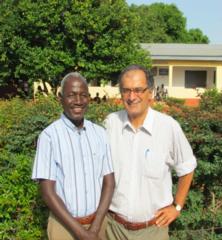 Given the example of Dr. Abdulai in a Tamalian context, I ask how places like Shekhina challenge us today. What is needed in our faith-conversion to reach to radical generosity in our school of the heart that makes a difference to the poor? Granted that every church ministry is essentially for the poor, the quality of Christian generosity has to be sacrificial in kind. Dr. Abdulai teaches me that medicine is not just a noble scientific profession to cure the sick but equally significant it ought to be a faithful servant of the Gospel. This shift in the paradigm of service requires a change in a heart that aches to understand the needs of the poor and continue to ache until it serves their needs. Conversion of heart negates egoism that prevents us from radical generosity in whatever ministry we find ourselves. Sickness can bring us together in ways we do not anticipate – a communion of saints so to speak – to challenge us how far can we go in sacrificial love. After all, a loving heart is a sacred heart. Until then, our formation continues in the school of the heart.
+++++++++++++++++
[1] On Christmas day each year, Dr. Abdulai opens his house to feed about three thousands of the poor
[2] There is in fact Evangelical Protestant presence with high-energy rituals spread in the city.
[3] The SVD is a German congregation founded by Fr. Arnold Janssen in the nineteenth century and train missionary priests sent to all continents. In Tamale there are SVD communities training seminarians in philosophy and theological studies.