Discourse on the Holy Spirit in the modern West appears to speak very little to our current life, because it seems detached from any notion of embodiment. Popular expressions of the Holy Spirit appear to hover free of bodies. Yet, any substantive talk about the Holy Spirit must be grounded in carnal existence, if it is to be both authentic to the full breath of the tradition and relevant to the world.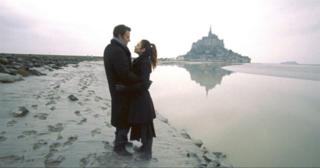
Talk of the Holy Spirit must transcend any false dichotomies of spirit and body; spirit and law. It must to speak to the relationship between the Spirit and the material world. Just as wine and bread are to be transformed by the Spirit into the body and blood of Christ, so the bodies of human beings are to be baptized, married, or ordained to be parts of the Body of Christ in the world. To appreciate the Holy Spirit it will not suffice to think spiritually; to appreciate the Spirit one must think materially and be committed to the physical world.
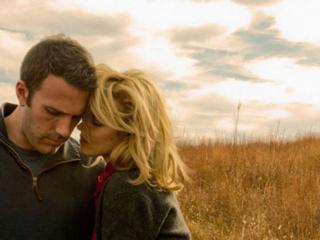 Terrence Malick’s recent beautiful and downright frustrating film To the Wonder offers us deeper insight that goes beyond the typical notion that regulates the Spirit to either the cognitive or emotive dimension. Though Malick does not explicitly deal with the Spirit, its anonymous presence exudes in the film. Yet, a word of caution, this is a film that I do not recommend for people seeking easy answers, because the film is painfully slow and does not give concrete resolutions. It seduces you with gorgeous sceneries, an amazing score, and the question of love.
The film follows the relationship of Frenchwoman Marina and American Neil, who fall in love in Paris and then return to Neil’s American home in Oklahoma. The romantic bloom in their relationship wilts. Alongside this is narrated the story of a struggling priest, who interacts with Neil and Marina along with his suffering parishioners.
From my angle, this film is a modern meditation on commitment to each other and to God. The drama in To the Wonder hinges on the struggle to give life into dying and listless relationships. The first word spoken in the film is ‘newborn.’
Both Marina and Neil struggle to transform their relationship into something that brings forth new life. Marina glamorizes love, whereas Neil does not fully know how to express his emotions. Malick shows the couple jumping through the hoops of building a relationship, and yet their physical home remains for all practical purposes unfurnished and undecorated. There is little in their physical existence that indicates commitment.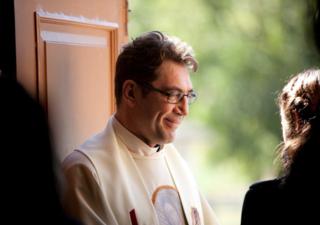
Then there is the struggling priest. He is enduring spiritual dryness. He wants to feel the love of God in his ministry again. To this end, he continues to devote his time to his parishioners, the poor, the sick and the imprisoned. He tries his best to commit to them even though he lacks emotional satisfaction.
This ending scene evokes in me the sacramental dimension of human existence. As Malick provides a difficult meditation on the problem of love and commitment in the modern world, we see at the end of the film the carnal dimension of true spiritual existence.
https://www.youtube.com/watch?v=G36SmOpsbvM
The recitation of the prayer of St. Patrick in this scene reminds us that God is not to be identified by simple contrast with the world (Kathyrn Tanner, God and Creation, Oxford: Blackwell, 1988), but with the world. Our ascent and return to God entails a descent and commitment to the world. The characters in this film struggle to allow themselves to be transformed by the Spirit, so that they can be the hands, feet, and face of Christ to one another.
The controversial Russian Orthodox theologian Bulgakov points out (The Comforter, Grand Rapids: Eerdmans, 2004) that the departure of Christ from this world in his Ascension does not mean that he is no longer flesh and blood or that he no longer can connect with humanity. The connection is to be made real in us through the gift of the Holy Spirit on Pentecost. Pentecost celebrates a new manifestation of Christ’s incarnation.
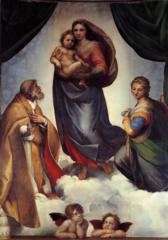 Our shortcoming at grasping the significance of the Holy Spirit lie in thinking that things spiritual have nothing to do carnal existence or earthly existence and everything to do heavenly existence. It has everything to do with our lives in this very world. Bulgakov once said that if he had to put a face on the Holy Spirit, the face would look like that of Raphael’s Sistine Madonna.
How provocative and appropriate that this controversial and brilliant theologian likens the physical description of the Holy Spirit to the feminine. It is Mary who gives birth to and nourishes divinity in this world. It is the Holy Spirit who gives life to the Body of Christ in this world. The Spirit works to shape and seek Christ in the world until the Spirit gathers all and unite all into the Father.