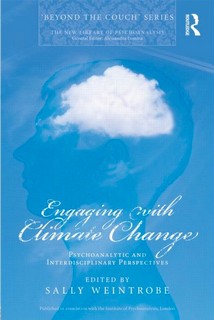
 Twenty years ago, a Jesuit psychiatrist, W.W. Meissner, produced an enlightening psychobiography of our founder (The Psychology of a Saint: Ignatius of Loyola – Yale University Press, 1992). Now in Engaging with Climate Change: Psychoanalytic and Interdisciplinary Perspectives (Edited by Sally Weintrobe, Rutledge, London, 2013), twenty-three psychiatrists, psychologists, historians and others have brought their expertise to bear on the growing ecological crisis in a way that helps break the current climate deadlock by producing a kind of psycho-ecology or eco-psychology.
History has shown us that people “do not readiy believe in new things until they have had a long experience of them” (Machiavelli), and that we can resist not only the evidence of our senses but even the warnings of scientists. James Hansen, an adjunct professor in the department of Earth and Environmental Sciences at Columbia University, has been bringing global warming to the world’s attention since the 1980s (see his Storms of My Grandchildren, Bloomsbury, New York, 2009), when he first testified before the U.S. Congress, only to find that, when studies are commissioned and reports listened to, they are then shelved and not acted upon.
To act on the findings of scientists like Dr. Hansen would mean challenging vested interests in giant coal and petroleum producing companies, to say nothing of the U.S. military, which has recently waged wars to secure oil for future wars.
As Bill McKibben pointed out in a recent article in Rolling Stone, forcing oil companies to leave the remaining oil in the ground would reduce their market value to zero, and there is no political authority that could ever persuade these transnational giants to do so. Oil will continue to be produced; coal will continue to be mined.
Canada, for one, has plenty of both, and is eager to sell to whomever is willing to buy. Our coal and oil will continue to be burned, and carbon dioxide will continue to be added to Earth’s atmosphere, increasing the warming that will up the intensity and frequency of blizzards and tropical storms.
Dr. Weintrobe claims that understanding human responses to climate change is just as important – if not more important than – understanding climate change itself. Her book is the intended outcome of a conference in which ten papers were presented and discussed by experts from various disciplines. Presenters also responded to the discussion afterward, so that there is here a depth and richness often missing when conference papers are simply gathered up and published.
The opening chapter is on the political and historical aspects of our engagement with climate change, while the concluding one deals with the science of global warming, with what is certain and what is uncertain. There is a high degree of certainty in the scientific understanding of climate change, which is based on 200 years of atomospheric chemistry and atmospheric physics. There are, however, problems with modelling the changes, and there is less certainty about how much warming we will see. 
The seven intervening chapters focus on different aspects of our attempts to engage with the issue of climate change, such as the psychodynamics of ecological debt and the psychoanalytical exploration of environmental subjectivity. There is also a fascinating chapter entitled, “On the love of nature and on human nature: restoring split internal landscapes.”
Though the book is not written from any faith perspective, it does raise the question of hope, and quotes Francis of Assisi to the effect that, even if he knew the world was going to end tomorrow, he would still plant a tree today.
The question we are left with, however, is how to encourage unselfish responses to the desperate situations that will confront many people and nations as denial gives way to the need to deal with the realities that are coming upon us, and coming sooner than was first predicted. Or, to put it in religious terms, how can we prepare now to love our neighbour as ourself when the instinct for survival and self-preservation will suddenly kick in?
Grieving will be a normal way of dealing with great loss, and depression will inevitably be part of this process as well. Dr. Weintrobe tells us that there can be no quick fixes. She calls for an “engagement that can lead to a radical, felt and lived reorientation in our relationships to ourselves, to others, and to nature.” She goes on to say, “Real unidealized leadershhip supports people in facing their feelings to make necessary difficut changes.”
Meanwhile, as The Toronto Star opined recently, the survival of the planet will depend on what happens in China over the next five years. And, we might add, in India. And in Brazil.