 This year’s series looks at the stories we live out of in our personal lives. To live is to be a pilgrim in time and as we journey into mystery, we discover we are constantly entering into one story and leaving another. We live our lives in stories. They shape our lives, our responses to life, and even our expectations about life. Conversion changes the stories of our lives. As we lean into the darkness of the mystery that surrounds us and try discern how to walk through that darkness, or how to wait in it, we find ourselves re-evaluating those stories.
 These stories come from our personal experience, from our family circumstances, from the society we find ourselves in, and from the cultural senses of time and place which establish our identity. But the stories we live out of also come from the way God sees and knows and loves us. Sometimes the stories we live out of are supported and reinforced by the story that is God’s story for us. At other times those two stories conflict.
As we journey into mystery, this conflict becomes more apparent, and we find ourselves caught up in a life or death struggle to embrace the path to the fullness of life we are offered daily. Then we are asked to abandon the limiting stories we have lived by and to enter more fully the story that God creates for and with us. Nowhere is that tension most clearly available to us than when we consider our past, our present and our future. These are not three separate aspects of our life in time: our past shapes our present and our future; our present shapes our past and our future; and our future shapes our present and our past. Each shapes the way we read the others. All together they give us some awareness of how we understand ourselves and how we value what we are given. But my self-understanding is not me. I am more than how I see and understand myself. I am more than a construction of time. I am a construction of God in time. I am still being created, still subject to forces, both benign and malignant, that affect my life.
It is our Christian belief that all of time—itself a creation—is held in God’s care, and that creation finds its fulfillment only in relationship to the Creator who loves it into being. Each of us is held in time, but each of us is also held in the timelessness of God’s love. Our journey through timelessness is often one that we do not pay overt attention to, caught as we are in our daily living.
 But that does not mean that Mystery is equally indifferent to us. The Desire who loves us and invites us to the fullness of life is always attentive to us. We, in turn, can become attentive to God, as a lover is attentive to the beloved, when we start noticing how our stories of our past, our present and our future are in constant dialogue with God. Such awareness brings us to the intersection between time and eternity where, with a sense of wonder, humility and gratitude, we perceive how we are being loved into being.
Our dialogue with God allows a moment of Incarnation to happen in our very own lives. God enters into our felt narratives, however they are constructed, to change those aspects that are life-denying and to affirm those that bring us closer to our true nature. These narratives might be perceived to be just intellectual constructs, but in fact they are rooted more basically in our lived and felt experience.
Often our learned theologies and catechisms present us with an image of God that we give intellectual assent to, but our felt experience of God—and the one we operate out of spontaneously—does not coincide with that image. So, when we are at prayer, what our image of God changes. The encounter is personal and mysterious, and does not subscribe to any ideologies. Indeed, if the energies of God enter any situation, it would be to restore the situation to a right relationship with God and allow it to be open to mystery, rather than to trap that relationship in circumscribed formulas. In prayer we allow ourselves to be touched and opened by God, at times beyond even the boundaries of our imagination.
Prayer allows us to know ourselves the way God knows us; as we discover this, we discover that our feelings towards God change. We open ourselves to wonder and awe, gratitude and humility. We discover we are loved even when we sin. We discover a God who desires to heal our hurts, celebrate our joys, and cover us with a transforming love. Only by resting in this love do we find the affirmation of our life that allows us to look at the dark sides of our human existence and to offer them up for transformation.
 The films in this series can be seen as contemplations which allow us to examine the stories of our past, how we live in the present and how we view the future. We hope you find reflecting on how they reveal to you aspects of your own life liberating and that they bring you to a deeper intimacy with a God who desires for all of us only the fullness of life. The films and the topics they reflect on are:
The Life of Pi (American 2012) – The Redeemed Past
Sacrifice (Chinese, 2010) – The Unredeemed Past
The First Grader ( British/Kenyan, 2010) – Transforming the Unredeemed Past
Scent of Green Papayas (Vietnamese,1993) – The Redeemed Present
The Master (American, 2012) – The Unredeemed Present
Salmon Fishing In the Yemen (British, 2011) – The Redeemed Future
Amour ( Austrian, 2012) – The Unredeemed Future
The Best Exotic Marigold Hotel (British, 2012) – Overview of Redeeming the Time
+++++++++++++++++++++++++++++++++++++++++++++
Finding God In the Dark: Taking the Spiritual Exercises of St. Ignatius to the Movies (Novalis) by Canadian Jesuits, John Pungente and Monty Williams, answered a need for those looking to have access to their spiritual life but who did not have access to spiritual direction. The award winning first and second editions of the book explore the Spiritual Exercises through contemporary film. The book is used by individuals, school and university groups, parishes, retreat centres throughout the world. 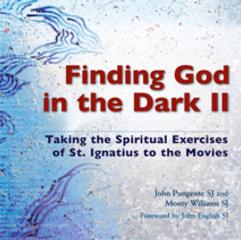
To make use of current films and to deal with further insights into the workings of the Exercises would mean re-writing aspects of the book. Since this is not a practical possibility, a web site. www.fgitd.ca was developed to deal with those issues.
That web-site uses current films to explore spiritual issues of concern to people today. The 2013 series – Redeeming the Time – which has just been uploaded to the web-site www.fgitd.ca allows users to explore the ways in which God uses our responses to our past, how we live today, and how we anticipate what is coming, to develop a deeper spiritual intimacy with God. Earlier series – beginning in 2005 – are archived on the site. Check it out . . it could change your life.