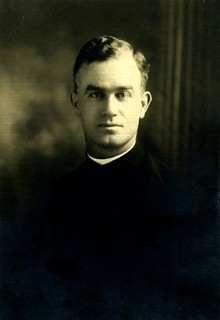
 When the Jesuits accepted in 1918 direction of the newly established Campion College in Regina, they had no money whatsoever to run the institution. Everything depended on Thomas J. MacMahon, SJ, the first appointed Rector there. He had to raise the money within a three months’ period, and it wasn’t easy. He relied on giving retreats, missions, preaching, speeches, and he begged.
By late August, he had scraped together barely enough to open the two rented houses on 13th Avenue for classes and for a Jesuit house. Not much fazed him, however, and certainly not the lack of money or the poverty-stricken living-conditions he and his fellow Jesuits shared. In time his fearless determination to make the college a success paid off.
Although money was still scarce by the mid to late 1920s, the college was flourishing. The Stock Market Crash of 1929, however, changed all that. Saskatchewan was hit very hard. The price of wheat fell to below the price of seed, and the fall-out smothered the province with poverty and unemployment. To worsen the situation, 1930 was the start of what became known as the “Dust Bowl” years or the “Dirty Thirties”, when severe drought and dust storms all but swept away the rich prairie soil, destroying the farms and people’s livelihood. That lasted for a decade.
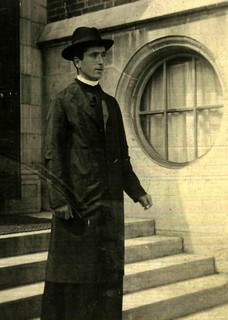 In very short order, the college was again penniless. When John S. Holland, SJ, became Rector in 1930, his task was enormous. There seemed almost no hope of any resolution to the financial crisis. Unable to pay with cash, many parents paid tuition and boarding fees in kind, with food, raw materials or clothing, or with whatever else they could put together, or by credit.
Along with almost everyone else in the city, Holland and the other sixteen Jesuits suffered considerable poverty and hardship. The students’ dormitories and the Jesuits’ quarters were sometimes without heat, despite the harsh winter climate, and food was scarce and of poor quality. Sometimes, the only daily fare was potatoes and bread. People struggled to survive.
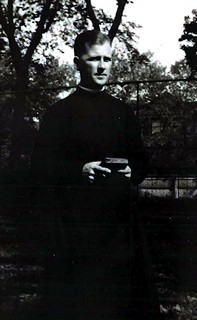 In the mist of such extreme poverty, Holland remained calm and determined not to give up. In the end, his serene temperament and mild personality gave the Jesuits much needed leadership. Frequently, he waived students’ tuition and fees for another day. Such kindness and understanding of the plight of hard-pressed parents won the hearts of very many. When he left Regina in 1933 to assume the rectorship of St. Paul’s College in Winnipeg, Campion College had improved somewhat its finances, although it was still in danger of folding from financial pressures.
Thus it was during the 1930s, with the Jesuits still experiencing real poverty and shortages of food. When Roderick A. MacGilvray, SJ, was appointed Rector in 1939, he found the financial situation of the college to be still hazardous. “We are,” he said, “a short stride ahead of the bailiff”. Yet it was a stride, and he was an optimist. When he stepped down as Rector in the summer of 1945, Campion was a changed place financially to what it had been six years earlier.
By the 1950s, life for the Jesuits there had improved from twenty years earlier, but they still lived in somewhat spartan quarters, and many times they felt the “pinch” of poverty. Travel was out of the question for the most part, their clothing was patched–their cassocks hid many a patched trousers and shirt!–and summer vacation was spent physically repairing the college or holidaying at the Stilton “villa”, a run-down dump of a place if ever there was one.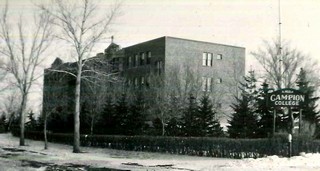
Things would remain that way until the 1960s when the Jesuits’ salaries took the edge off the financial restraints of the Community.
Was it any wonder that years later during the 1980s, what many in Regina still remembered most about the Jesuits of the 1930s to the 1950s was their commitment to their educational ministry and to a life filled with poverty!