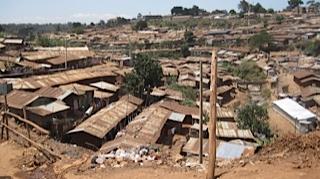
 “God made the world round so we would never be able to see too far down the road.” – Isak Dinesen (Karen Blixen)
When I arrived in Nairobi at the end of December, I came with many different images of Africa and ideas of what my short time here would hold… most of them turned out to be inaccurate. AJAN and the many people I have met here have provided learning opportunities across a range of topics: African culture, poverty, Kiswahili, basket making, community, Jesuit mission and liturgical dance to name but a few. As you would expect, I could have never predicted most of the experiences I have had. But somewhat surprisingly to me, some of the things I thought I knew well have also been turned upside down.
I remember the first time I heard of AIDS, I was 14 years old and Rock Hudson had reportedly died of it. It was everywhere in the news from “safe sex” campaigns and experts trying to explain the little they knew about the virus in order to quell public panic to celebrities encouraging us to support AIDS causes and research. It was almost impossible to escape the topic. At that time, there was so little understood about the virus. It seemed to target specific communities; it was transmitted sexually and through blood transfusion; and, it was deadly.
At university, I chose to study virology in order to be exposed to the cut-edge research that was being done in this field. So much was happening –discoveries were being reported on a weekly basis. If one could imagine a positive outcome of HIV, it was the scientific advancements this research led to across a number of fields: drug discovery, epidemiology, virus transmission, public education, etc. After university, I joined a pharmaceutical company that produced one of the first anti-retroviral drugs used to manage HIV. I thought I knew a lot about HIV.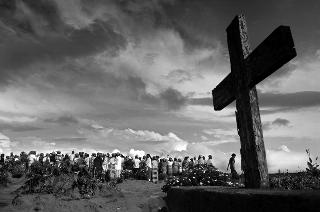
Within the first two weeks of arriving in Nairobi, I attended the funeral of a family member of an AJAN colleague. This experience shaped my entire time here. Wangari was in her mid-30’s, a wife, a mother, a devout Christian and a woman who had battled with AIDS during the last 2 years of her life. I was told that she had suffered from several opportunistic infections during her illness and had been bed-ridden for the last few months due to a severe respiratory ailment – probably, pneumocystis pneumonia or tuberculosis.
While I was very aware of the statistics that characterized the African HIV pandemic – that millions of individuals are currently infected and that millions more have died from this virus – it was only while I walked through the cemetery and saw the ages listed on the dozens and dozens of tombstones I read did this reality hit me: many, many, many young people, people in their 20’s and 30’s, people with young families and their whole lives ahead of them, die from AIDS in Africa. I naively asked one of my colleagues walking with me if some of these individuals would have died from AIDS. He said “Absolutely – probably most of them” and added that it is very rare to meet a Kenyan that hasn’t had a friend or family member killed by the virus. Any out-dated, North American image of HIV/AIDS that may have been still lingering with me was quickly shaken.
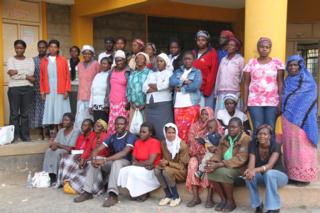 It is not all bleak – quite the opposite. The work done over the last two decades to prevent the spread of HIV in Africa has been very successful. It is changing the course of this tragedy. As in Canada, many people living with the virus in Africa now lead very happy, full lives. While this is encouraging, it is not a reason to slow the much needed efforts to continue promoting prevention, ensuring access to HIV medication, eliminating barriers like stigma that is still associated with HIV and that inhibits testing and treatment and, most importantly, ending this pandemic.
I was very fortunate to observe several other realities of HIV/AIDS during my work at AJAN: o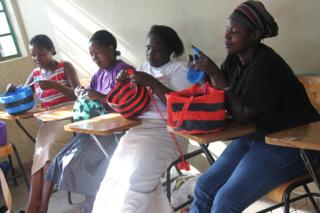 nes filled with hope (a young adults’ church group attending a lecture series on prevention and healthy sexuality), compassion (an HIV+ men’s group that meets monthly to discuss their challenges and support each other) and courage (a women’s income generating activity that provides members with both emotional and financial support). Seeing Wangari’s son standing by her coffin and the tombstones marking of the virus’ many victims may have been one of the most striking images of HIV/AIDS I encountered, but it is certainly not the only one I will take with me.
Karen Blixen had it right with her theory on why God created a round planet for us. As with all of my Novitiate experiences, my time at AJAN has taught me many things, among the most important, to work at leaving behind preconceived ideas and to live peacefully (that might be a stretch) with uncertainty. Trusting in the unknown and the sense of discovery it fosters are two of the greatest graces I have received (both of which are clearly ongoing lessons). Together they create openness and freedom and deepen our sense of observation to help us absorb lessons and follow God’s guiding hand to opportunities that might have otherwise been missed.
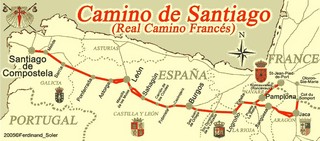 So, with only a glimpse of the horizon to come, I am now off to northern Spain to walk the almost 800km of the Camino Francés from the French border to Santiago de Compostela. While I hate to leave Nairobi, I am very excited to make my Camino pilgrimage. It will give me time to reflect on my many experiences lived during my Novitiate, particularly my time at AJAN.
Oh, the life of a novice…