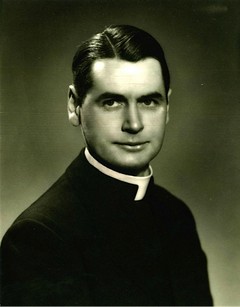
 “Q” was an eccentric. He was known as “Q” by his fellow Jesuits because his name was Edward Quinton Moriarty. Students at Loyola High School in Montreal called him “Mort”. Certainly in every way he was a character, a source of constant amusement to students with his odd accent, loping walk, and strange hand movements. He was easy to mimic.
Moriarty was born in the tiny village of Nashua, New Hampshire. Yet he never wanted to reveal his birth-place; he preferred to pass as a Bostonian, a small deception which he carried to his grave. Those who knew him cared not a whit where he was born.
Moriarty did. Each year he spent his summers in Boston, where he had earned his Master of Arts degree in history, to perfect his vowels and inflection of speech. Or so his fellow Jesuits at Loyola teasingly suggested.
He spent his life as a high school teacher, and despite his eccentric mannerisms and firmly set beliefs, he had sound pedagogical methods. A good but exacting teacher of history, always he had the best interest of his young charges at heart, and understood thoroughly their mind-set. True, his strange habits, his slow, methodical gait, and his Americanisms and accent, were a source of endless enjoyment to his students.
Indeed, from their side, Moriarty was an unforgettably colourful Jesuit teacher. He would pace back and forth in front of his class, gesticulating all the while with his right hand while, in an extraordinarily uncoordinated way, his left arm circled about in wide motions with fingers splayed out.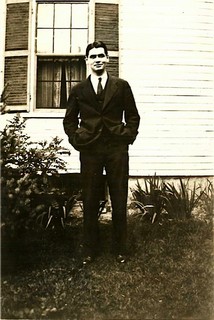
Yet, no student ever doubted his dedication as a Jesuit priest and teacher, or ever queried his learning or passion for history, or ever forgot his presentation of it.
Blunt of speech, he called “a spade a spade”, a phrase he repeatedly used. He had his “partialities”, he insisted, and the “players” of history were his favourites. He would relate stories interspersed with “pithy bon mots”, as he liked to say, from his selection of historical figures esteemed for their “manly” feats.
Napoleon Bonaparte, Otto von Bismarck, American Presidents, Babe Ruth, Vince Lombardi, all were his heroes to be admired and imitated by the students. From year to year his stories never changed, his ideals remained firmly set.
Yet too, he loved music, especially jazz, and he could play the clarinet and saxophone adequately well. His singing voice was unquestionably less impressive. That never prevented his breaking into song.
Many a student or teacher at Loyola was surprised to have Moriarty suddenly burst forth singing one of his much-loved Broadway musicals, or even more discomfortingly, a tune from an Italian opera. An opera tune sung with his accent could never be forgotten!
When in 1981 Moriarty retired from teaching, Loyola lost a most unusual Jesuit teacher. Students missed him and his eccentricities. In the years after leaving Loyola, they would not forget his unusual mannerisms and accent, but they also would not forget what he had taught them. That was what he really wanted to achieve, and so he did.