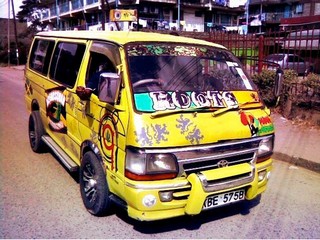
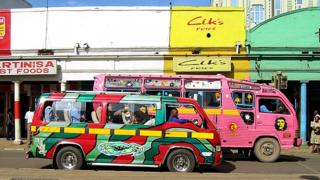
 Matatus are privately owned minibuses that serve as the major form of public transportation in Nairobi. The name is a Swahili colloquialism based on the word tatu meaning “three”. One explanation is that the name is derived from the original pick-up trucks that were fitted with three rows of wooden benches and a canvas roof. Another is that the original minibuses cost three pennies to ride. The conductor would call out “mapenny matutu” (translated as “three pennies” in Kiswahili) which was then shortened to matatu over time. Whatever the origins of the name, the drive is always an adventure. I have never felt closer to God then when I am experiencing life in a matatu.
Matatus follow set routes (usually). Passengers are picked up along the side of the road or at stages or stands at major hubs like shopping centres or outdoor markets. There are no marked stops or posted routes so you have to know and trust what the driver tells you. Drivers are skilled at spotting perspective customers amid a sea of people as they maneuver through unrelenting traffic and construction all the while fighting other matatu drivers that are trying to squeeze them out.
In addition to the driver, matatus are staffed by a conductor known as a manamba. 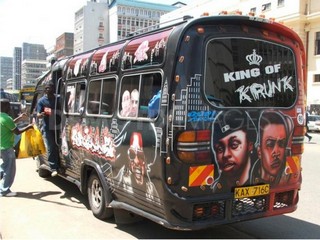 They hang from the matatu while it careens at break-neck speeds through the streets and work tirelessly at hustling passengers into their vans in the highly competitive matatu environment. They know everything that is going on in and around the vehicle at all times – it is exhausting just watching them.
Each matatu’s décor is unique and creates somewhat of a theme, from the type of lighting and signage used to the choice of music played. For example, they may have portraits of famous people like President Obama, Pope John Paul II or Miley Cyrus (this choice was part of a much larger inspiration) and sport religious sayings or scripture references. In addition to the bright colours, pictures and slogans, upscale matatus often have Christmas lights or those fluorescent strips used for under-cabinet lighting draping the inside ceiling of the van and even louder sound systems playing the likes of Josh Groban or Bob Marley (matatu staff have eclectic tastes).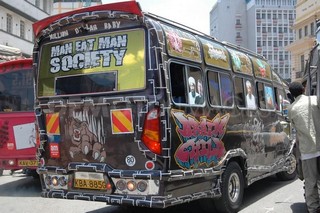
Extensive regulations were introduced in 2003 mandating that matatus must be fitted with seatbelts (which are usually broken) and electronic speed limiters to keep speeds below 80 km/hr (often disabled to allow for driver freedom). Other regulatory controls include not playing music loudly (always deafening but an essential contributor to the matatu’s theme), limits to the number of passengers allowed at one time (it’s rare to not have someone sitting on your lap), excessive decoration (define “excessive”) and restrictions on matatu workers wearing too loud a shirt (define “loud”). The Kenyan philosophy of kitu kidogo, meaning “a little something”, seems to help the matatu staff duck any infringements that are caught during frequent police road blocks.
The old maxim “cleanliness is next to Godliness” is not espoused on a matatu. That said, the presence of God is palpable. The closeness with the other passengers creates a sense of unity and dependency – strangers jammed together traveling the same unpredictable path. You cannot help but feel connected. There is also great vulnerability even humility that exists in the experience. It is one of the rare moments that I share in the poverty and neediness that exists here in Nairobi… not an observer but an active participant.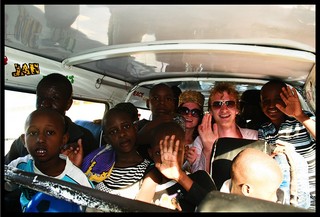
I love being a part of the huge variety of people sharing the ride; all going about our day carrying with us our struggles, joys, fears, hopes, etc. There is usually one person that grabs my attention: a young mother with 3 or 4 children hanging from her, a woman carrying huge bales of produce or clothes or containers of water she will try to sell at the local market or an older person who struggles just to get into the bus. The difficulties of life are very present – it reminds me of how much I have been given and how much I need to give back.
I have experienced so much kindness and generosity from fellow travelers throughout all of my excursions. I am obviously an outsider; it is extremely rare is see another mzungu – a white person – on a matatu. Despite the busyness of the surroundings and tending to their own needs, I feel my neighbours watching out for me, translating my requests, explaining the matatu’s route, giving advice on directions or ensuring that the conductor charges me fairly. In all this chaos, I still feel safe and somewhat protected.
There is also inherent risk in the experience which contributes to knowing God is travelling right along with me. Matatus are known for their high speeds and erratic driving, and while I am not purposely testing God, I am constantly trusting that things will go according to his plan. You are never really in control in a matatu. It is one of the rare opportunities when all you can do is pray and trust.
 With many matatu experiences now under my belt, I am debating whether to take it to a “whole other level” and try a spin on a boda-boda – a scooter that has a passenger seat built for one but that is often occupied by many more people. In fact, I have seen as many as 6 people on a boda-boda at one time: 2 adults and 3 children in addition to the driver. It was obviously the clown car version. My only hesitation in attempting a boda-boda ride is the feeling that I still need deeper spiritual conversion before I test God’s providence at this level!!
I understand the Kenyan Government is working to phase out matatus in favour of larger, safer city buses. I am not sure that this will ever be realized as the matatu seems to be an imbedded part of the culture here. However, if they do success, I have no doubt God’s presence will continue to be felt throughout Nairobi – but possibly not as discernibly as it is in a matatu.