It is two years since I experienced the first symptom of the disease. I received the diagnosis of cutaneous anaplastic T-cell lymphoma in late August, 2011. I have been receiving treatment in o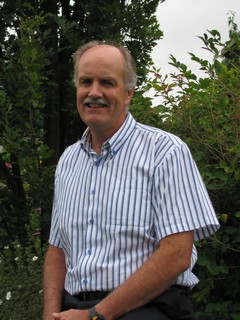 ne form or another since. Presently, after other chemo treatments did not achieve the desired results, I am undergoing a more toxic chemotherapy with some positive effects. I will undergo a stem cell transplant in the near future.
A world has opened before me since the diagnosis. I have spoken with so many people who have cancer or have had cancer. My younger sister has been living with cancer for three years, and has just begun treatment for the second time. Friends and a cousin have died from cancer since my diagnosis. The cancer treatment centre in Kitchener, where I receive my treatment, treats about 90 people a day with chemotherapy. There is also a radiation unit at the centre. Clearly, cancer is an epidemic in Canada.
I have never felt more at one with Earth than I have during this cancer journey, I have identified with the struggle of Earth. Earth has cancer! Climate change is the fever of a sick planet. Do we need to look beyond the year 2012 to convince us that climate change is now the reality with which we live?
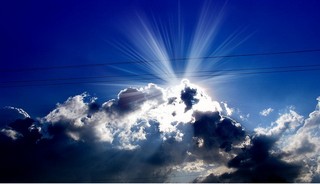 2012: The hottest year on record in North America; the year when in Guelph the forsythia shrub bloomed in winter, our farm’s apple blossoms bloomed early and then were killed by a frost, and our vegetable production suffered greatly from the driest growing season on record; the year that Europe had a cooler and wetter summer than normal; the year of Hurricane Sandy; and the year which further increased the temperature of ocean waters, including the Arctic, confusing a pod of orca killer whales to stay longer than normal getting them caught in the ice. What used to be much more predictable and routine is now unpredictable.
2012 was also the year of the US election, an election in which the environment was not an issue, and neither climate change nor the environment received any attention at the many political debates. Denial seems to be one of the few responses that we can predict.
David Servan-Schreiber states that cancer is a “rich person’s disease.” It is much more prevalent in the West than elsewhere. He argues that three major factors have drastically disrupted our environment over the last fifty years contributing to the rise in the disease: 1) the addition of large quantities of highly refined sugar to our diet; 2) industrial agriculture and the resultant changes in our food; and 3) exposure to a large number of chemical products that didn’t exist before 1940. Cancer is a symptom of a sick planet.
While cancer may be the disease of the rich, its treatment is also the luxury of the rich. Our cancer treatment medical system is very expensive. In Jamaica, where I once worked with hillside famers, a farmer I knew was diagnosed with cancer. He simply went to the hospital to die. 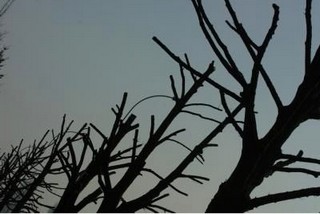
So where is the hope? I do not know what the prognosis of my cancer is, but it does not seem that great. Certainly in the time since I began treatment, the disease seems to have resisted most treatments. With the ecological crisis, it is unknown whether we humans will get our act together in time to do much about it. There does not seem to be a lot of reason for optimism. In fact, one could argue that pessimism is the realistic response to the situation.
The good thing is that optimism is not hope. Hope requires an act of faith – faith which is based on the individual and communal experience. When I look at a situation I look at the facts and can be optimistic if the facts are positive. As Rabbi Jonathon Sacks states, “It takes no courage to be an optimist . . .” I can look at a situation and be drawn to pessimism, yet remain hopeful.
My cancer journey has brought me to the cross more than once. I experience the passion of Christ in my journey. I identify with Jesus as he went to the Garden of Gethsemane and surrendered to his suffering and death. I also experienced the cross when I looked at the fruitless apple trees this fall, or saw the television footage of the pod of orcas struggling to breathe through a small hole in the ice, or see the destruction of the ecosystem by the development of the tar sands, or witnessed the frenzied consumerism as we celebrate the incarnation. God acting in Creation. God suffering in Creation.
I have great confidence and hope in the ability of Earth to be about life. The Earth will survive this ecological crisis. In its 13.7 billion year history, it has survived many crises before. Earth is about life. Death sustains this life. There might have to be much death, suffering and pain for the life of the planet to survive, and this may have to happen by the extinction of the most destructive species. I hope that this may not need to be the case, but even if it be, the ultimate life of the Earth will be an expression of Christ risen, of life from death.
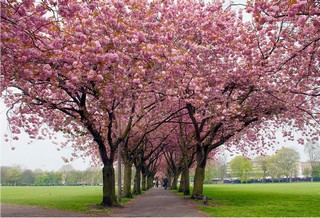 Just as a new dawn, the life of spring after a life-deprived winter and the log in the bush are expressions of Christ risen after an experience of death, Christ risen will continue to be expressed and probably in ways in which we cannot imagine. As Ilio Delio states, “Resurrection is the necessary death awaiting us for new life to emerge in the cosmos. The old is necessary for the new; death is necessary for life.”
Such hope fuels my desire to be healed so that I may continue to participate in and contribute to the life of Earth. Such hope also helps me to see the resurrected life present before me as I witness the quest for an evolutionary spirituality that is inclusive of all Creation, see new movements demanding our governments to do more to protect the earth, experience the development of the local organic food movement, learn of the commitment of a large corporation such as the Walt Disney Company to responsible forest practices and conservation in the sourcing of all its paper, and since the election hear President Obama express his desire and determination to do something about climate change. Such hope enables me to be more optimistic.
I am not sure at this point if the end of my cancer journey will be healing, yet I know that it will be life. I am not sure how the resurrected life will be expressed, but I am confident that it will be. I am confident of this because this has been my experience, my lived experience of Jesus, and my experience of Earth as I see a decaying log in the bush enriching the soil producing life. It has also been the collective experience of my faith tradition from which I draw much wisdom.