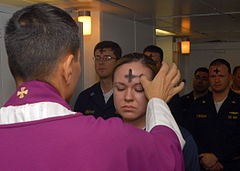
 There is a long tradition going back to the early Church of a time of fasting, penance, and asceticism before the liturgical memorials of the Passion, Death and Resurrection of the Christ. Today one hears of people giving up things: chocolate, alcohol, foods of certain sorts, or taking up things: a daily rosary, or the reading of a devotional book, or the practice of a pious exercise.
They may do this because it is an ecclesial custom for this time of the year. Or they may do it because they seek to imitate Christ of Philippians 2:1-11. Just as how he "did not count equality with God as something to be held onto but took on human nature" so too those give up some of the delights in living for austerities.
All of this is very edifying. When people come to me for spiritual direction and they tell me what they are going to do for Lent, I ask them a simple question: Did you ask God what you should do, and have a prayerful discussion about what to do?
Often they are surprised by the question. They focus on the notion of sacrifice as giving up something. They see it as penance for their sinfulness, or an imitation of Jesus's own sacrifice.
But the word "sacrifice" comes from two Latin words, "sacer" meaning "holy" and "facio" meaning " I make." We need to ask if what we intend to do for Lent will make us holy, will bring us to a closer intimacy with God, and more loving relations with others.
Often the things we chose to do, or not do, for Lent are decided by our super-ego, rather than discerned through prayer. As a result what we do re-inforces our ego through acts of will power. We become more trapped a sense of self that substitutes its own notion of righteousness for sanctity which only comes from a living relationship with God.
Lent invites us to see, know, and love ourselves and each other the way God sees, knows and loves us. The asceticism we are invited to is to abandon masochistic and sadistic ways of living for then "the kingdom of heaven is overtaken by violence, and the violent bear it away."
Rather than beating up on ourselves, and others, we might want to ask ourselves: how do we do this? We might want to take this season of Lent to learn how to stop doing this, and to ask ourselves what good and healthy habits can we develop which makes us more loving, and thus more human.
Once someone came to me to discuss what to do for Lent. I told that person: Ask God. Every week that person came back to me and said I have been asking but I get no answer… I try all sorts of ways of getting an answer but nothing comes. It went on that way all Lent.
After that Easter that person came to me and said, "I don't think I made a good Lent… I didn't do anything ." I said, "That is not true…. You presented yourself to God every day in humility and in an earnest desire to be of loving service…. You waited on God." 
In his earthly life Jesus waits on the Father; in our following of Jesus, as the Way to the fullness of life, we too wait on the Father. Lent is a learning how to wait. We learn to wait only by waiting. It is an experience, for God does not give us answers, God gives us experiences.
What we experience by such waiting is our selves as creatures, radically and totally dependent on the Creator. Such waiting takes lots of nonsense from our lives. It takes away the lie that we are the centre of our lives and are in control of it. Such waiting carries us out of our fears which trap us in security.
It leads us to discover our poverty of spirit which opens us to seeing how we are all rooted in God's compassionate mercy. It carries us in the depths of Mystery beyond human understanding and control. It brings us to the Pascal
Mystery where human vulnerability encounters the forces of destruction unleashed upon our world.
There one turns to God and waits on God, as the Christ did on the cross. There one discovers in waiting that death is not the end of life, but the door to a new transformed life. In waiting one discovers a God who comes to one and invites one to share in the ongoing work of liberation.
There we discover being made in the image and likeness of God we share in the creativity of God as we too become creative. Such creativity is a making holy where to be holy is to be united to the life of God by living the life God offers to all. Becoming holy starts at Lent. It starts with a simple question to God. "What do you want me to do?"